

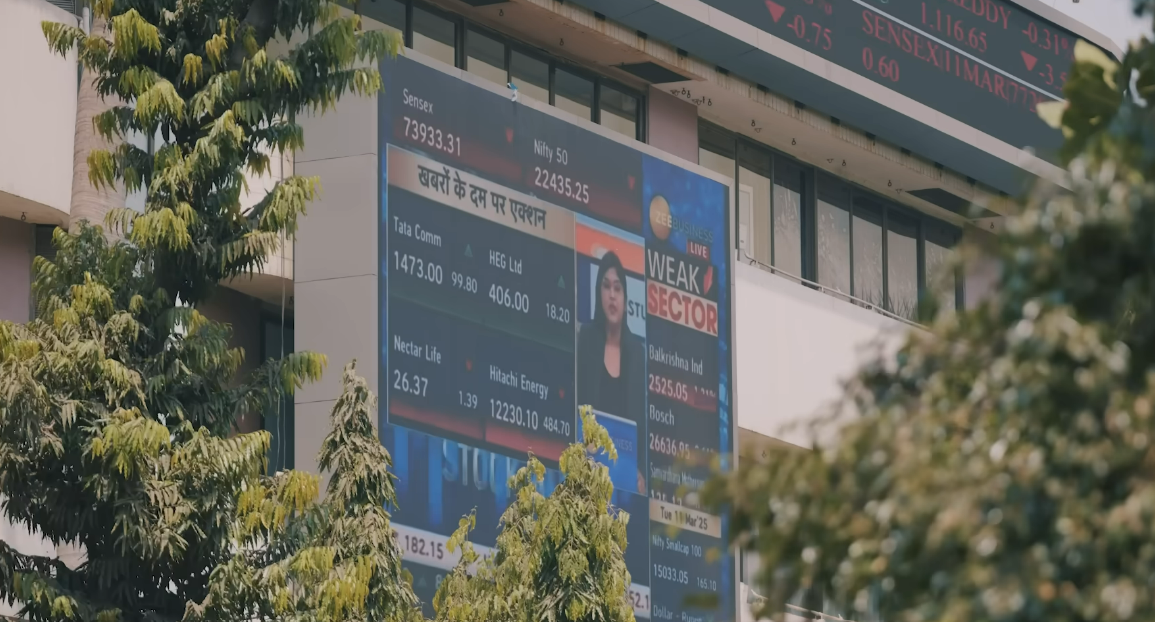

In Mumbai’s Bandra-Kurla Complex, the dealing room is rarely quiet. Traders lean forward in their chairs, screens flicker continuously, and voices overlap in bits of Hindi, English, and numbers. But recently, there has been an unusual hesitancy as the IT sector tickers have declined. It’s not anarchy. Something more subdued. Perhaps.
In the first half of February alone, foreign investors withdrew nearly ₹11,000 crore from Indian IT stocks, drastically cutting their holdings. Even though the numbers are dramatic, the atmosphere is even more somber. Like farmers looking to the sky for rain, traders look at Infosys and TCS prices for indications of a recovery that hasn’t yet materialized.
Perhaps artificial intelligence is now more of a psychological story than a technological one. Investors seem to think that India’s long-standing outsourcing advantage could be weakened by AI tools that can generate software code. The premise, which permeates international markets, is straightforward but unsettling: why employ thousands of engineers in Bangalore if machines write the code?
| Category | Details |
|---|---|
| Sector | Indian Information Technology (IT Services) |
| Key Companies Affected | Infosys, TCS, Wipro, HCLTech, Tech Mahindra |
| Recent FPI Selloff | ₹10,956 crore sold in first half of Feb 2026 |
| Decline in FPI Holdings | Fell nearly 16% to ₹4,48,938 crore |
| Core Concern | AI tools potentially replacing traditional IT services |
| Market Impact | Nifty IT Index down sharply; major stocks fell 10–15% |
| Industry Size | Approx. $283 billion Indian IT services industry |
| Reference Links | https://www.nseindia.com |
| https://www.nsdl.co.in |
That notion seems oddly out of touch with reality as one strolls along Bengaluru’s Outer Ring Road, where glass office towers rise alongside tea stalls and construction cranes. Every morning, employees still arrive on campus with their coffee cups and ID cards, following the same routine. However, decisions made by portfolio managers far away—possibly in New York or London—have an impact on these structures.
Investors seem to be responding more to what AI might do than to what it has already accomplished. And that difference counts. Even now, enterprise software is still highly customized and disorganized. Whether AI can completely replace the human layers needed to set up, maintain, and secure these systems is still up in the air. However, in financial markets, uncertainty frequently acts like fact.
Stocks have dropped by double digits in a matter of weeks as a result of the selling, which has been quick enough to wipe out billions in market value. The shares of Infosys have dropped significantly, and even TCS, the industry leader, has been hit hard. As we observe these declines, it seems more like a sudden change in narrative than a slow reevaluation. The dependable growth engine of the past is now being viewed as a possible casualty.
Naturally, investors have already seen this film. Similar concerns arose in the early days of cloud computing, with forecasts that traditional IT services would lose their relevance. Rather, those businesses adjusted, changing their business plans and generating new revenue streams. AI might behave similarly, upending traditional tasks while opening up previously unimaginable opportunities.
The timing couldn’t be worse, though. After years of growth, Indian IT companies were already experiencing slower growth, and AI arrived just as investors were beginning to hope for a recovery. It appears that the reaction is being exacerbated by the collision of expectations and uncertainty. Current earnings are not the only thing that markets price. Future stories are valuable to them.
This change is also being driven by a deeper emotional layer. Sitting thousands of miles away, foreign investors might simply have more faith in Silicon Valley’s automation promise than in India’s adaptation promise. It’s not always a judgment based on performance as of right now. It is a wager on future supremacy.
However, adaptation has already started on Indian IT campuses. Instead of opposing AI, engineers are embracing it by learning new tools, experimenting with it themselves, and incorporating it into current systems. Observing this shift makes it seem more like evolution than an extinction event. However, markets are not immediately reassured by evolution.
The fact that valuations have now dropped to levels that some investors find appealing raises the possibility that fear has overestimated reality. The selling hasn’t entirely stopped, though. Whether this is the bottom or just a pause is still unknown.
In actuality, AI is transforming more than just technology. Confidence is shifting. Furthermore, once confidence is damaged, it takes time to regain.
There is a sense that something significant is being tested as you stand outside one of Bengaluru’s tech parks at dusk and watch office lights flicker on floor by floor. not only the value of stocks. not only business plans. But faith itself.
