

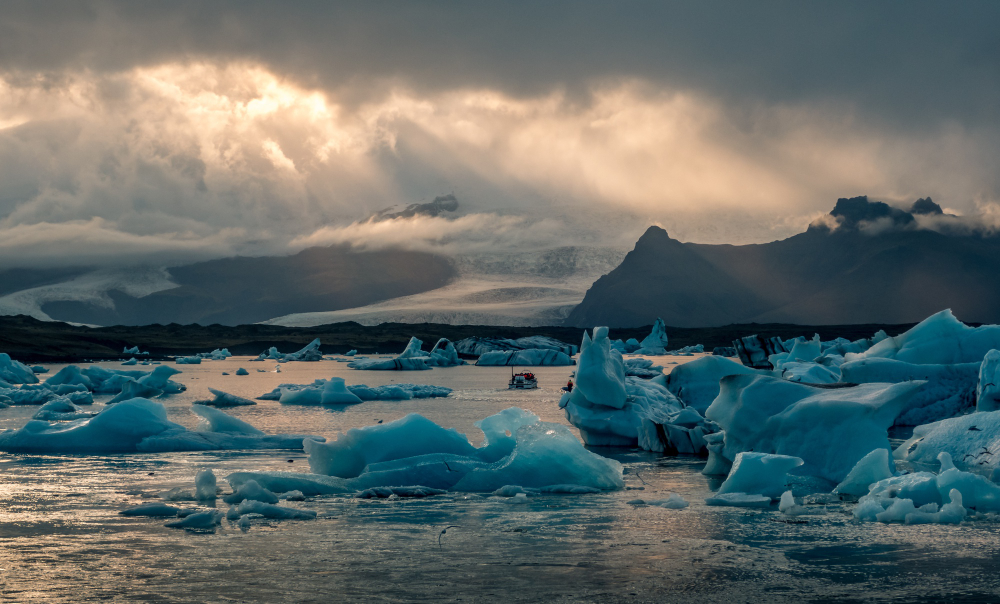

There is no dramatic sound to the wind at Crary Ice Rise. It makes a hissing sound. It makes a scraping sound. As though the world has been reduced to cold and light, it transports snow across a flat, white horizon that has an almost abstract quality. However, beneath that silence, scientists have discovered something astounding: 23 million years of climate history concealed beneath more than 500 meters of Antarctic ice, layered in stone and mud.
The closest research station is about 700 kilometers away from the drilling site, which is situated along the edge of the West Antarctic Ice Sheet. A small international team drilled steadily downward for two months while living in tents fastened against katabatic winds. There had been two unsuccessful attempts. The apparatus froze. Systems became stuck. The ultimate achievement feels more like the fruit of unwavering perseverance than it does like standard fieldwork.
| Category | Details |
|---|---|
| Project Name | SWAIS2C (Sensitivity of the West Antarctic Ice Sheet to 2°C) |
| Location | Crary Ice Rise, West Antarctica |
| Ice Thickness Drilled | 523 meters |
| Sediment Core Length | 228 meters |
| Climate Record Span | Approximately 23 million years |
| Lead Institutions | ETH Zürich, Victoria University of Wellington, Binghamton University |
| Key Focus | Ice sheet sensitivity to warming above 2°C |
| Reference | https://www.ethz.ch/en.html |
The longest sediment core ever drilled from beneath an ice sheet is the 228-meter core they recovered. Just that fact would garner media attention. However, it’s the contents of the core that both fascinate and unnerve.
The rock and mud preserve environmental signals that date back about 23 million years, layer by layer. Something that seems almost unreal when standing in that frozen desert is suggested by microscopic marine fossils embedded in some strata: this location was once covered by an open ocean. pieces of shell. organisms that rely on light. Proof that sunlight used to reach the waters where a half-kilometer of ice currently presses down.
It’s difficult not to stop thinking about that picture. There may have once been waves where there is now a frozen plateau.
What happens to the West Antarctic Ice Sheet when global temperatures rise more than 2°C above pre-industrial levels is a critical question that scientists working on SWAIS2C are attempting to answer. Although the discussion is less political and more geological in nature, that threshold echoes the goals of the Paris Agreement. The sediments seem to document times when Earth’s temperature was much higher than it is today.
Sea levels could rise by four to five meters if the West Antarctic Ice Sheet completely melts. In policy talks, that figure frequently floats in the air. However, it feels less theoretical when scientists work with a piece of core that is dark, gravelly, and occasionally sand-streaked. Physical memory is what this is. A slow-written climate journal spanning millions of years.
On-site preliminary dating was carried out by identifying small marine fossils, a delicate procedure carried out in a temporary polar lab under careful lighting and gloved hands. It will take years to complete the analysis. The precise time and speed of the ice’s retreat remain unknown. However, preliminary indications point to significant changes between open ocean conditions, floating shelves, and grounded ice.
It seems as though climate science has spent decades assembling the puzzle from its fragments. The ice sheet is rapidly losing mass, according to satellite observations. Warming scenarios are simulated by models. However, up until now, sediments close to the ice margin or ocean basins farther out have provided a large portion of the geological record. This core originates right beneath the actual ice sheet. That difference is important.
Some of the warm periods that have been documented here might be similar to the world that we are moving toward. Sea levels were significantly higher during some ancient warm periods, but carbon dioxide concentrations were not significantly different from pre-industrial levels. Although it moves slowly, the climate system is in motion.
The scientific community is quietly tense as they watch this play out. No one wants to draw sweeping conclusions before the data has been thoroughly examined. At the same time, the sense of urgency is evident. The term “Antarctic frontier science,” as one researcher put it, doesn’t seem overly dramatic. It takes both engineering and science to remove more than 200 meters of sediment from beneath an ice sheet in such a remote location.
Cores were arranged in three-meter-long segments inside the field camp, cataloged, and wrapped for transportation. It was remarkably variable, with coarse gravel that suggests iceberg activity sitting next to fine mud typical of subglacial deposition. These shifts depict advance and retreat, shifting grounding lines, and the thinning and reforming of ice.
One might be tempted to view 23 million years as an incomprehensible amount of time. However, geologically speaking, it is a relatively new chapter. For more than 30 million years, the continent has been encased in the Antarctic ice sheet. This core implies fluctuation rather than stability.
We seem to be at a precarious intersection between historical evidence and contemporary acceleration. There is no ideal blueprint for the future in the past. Different configurations were found on continents. Currents in the ocean changed. However, trends continue. Warmth causes ice to react. Sea levels come next.
The core has currently left Antarctica and is en route to New Zealand and other locations for in-depth laboratory examination. Scientists will refine timelines, measure isotopes, and examine mineral content. There are years of work ahead.
However, a fundamental event has already taken place. Quietly, methodically, a record has emerged beneath one of the world’s most remote stretches of ice, reminding us that Antarctica has not always been frozen and that the climate system has a longer memory than quarterly reports or political cycles.
What emerged from beneath the ice is ultimately more than just sediment. It’s a matter of perspective.
