

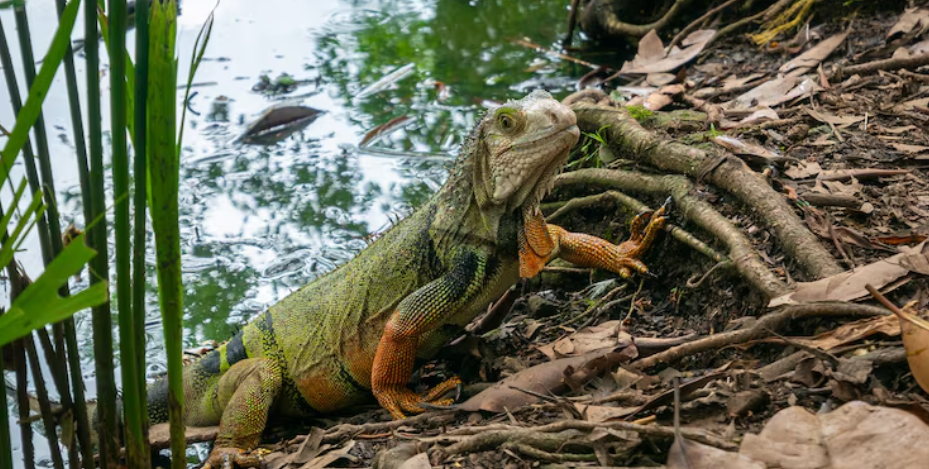

Standing in front of a crocodile enclosure is unsettling. The silence seems intentional. The eyes hardly move. Nevertheless, it’s difficult to avoid feeling as though you’re staring at something that has witnessed the end of the world and has chosen to ignore it when you watch one blink slowly under a muggy sky.
The Earth did not simply change sixty-six million years ago. It shook. When a huge asteroid struck what is now Mexico, it ignited forests, sent shockwaves across continents, and lifted enough dust into the sky to block sunlight for months. It’s possible that ecosystems that were once teeming with life were overtaken by a chilly silence that seemed to go on forever. Under the weight of it all, dinosaurs—dominant, varied, and seemingly unstoppable—collapsed. However, not everything disappeared.
| Category | Details |
|---|---|
| Topic | Evolution of Crocodilians and Dinosaur Extinction |
| Time Period | Mesozoic Era (≈252–66 million years ago) |
| Key Event | Cretaceous–Paleogene (K–Pg) Extinction (~66 million years ago) |
| Surviving Lineages | Birds (avian dinosaurs), Crocodilians, Early Mammals |
| Notable Traits (Crocodiles) | Low metabolism, amphibious lifestyle, dietary flexibility |
| Scientific Focus | Evolutionary adaptation, extinction survival strategies |
| Reference | https://www.nhm.ac.uk/discover/why-did-the-dinosaurs-die-out.html |
By then, crocodiles were already very old. Additionally, the more you consider their survival, the less it seems like luck and more like design, albeit not in the grand, heroic sense. It’s more like a silent, nearly unyielding resistance to change.
Dinosaurs were designed to move, particularly the large carnivores. You can practically picture them—constantly burning with energy, restless, and scanning the horizon. Fuel is necessary for that kind of life. Much of it. Herbivores starved first when plants died off in the protracted darkness, and predators that depended on them soon followed. The system as a whole seems to have fallen apart like a set of dominoes, with each piece relying too much on the one before it.
The way crocodiles behaved was different. It is evident when you watch one bask in muddy water for hours on end. They preserve. They can go weeks or even months without eating because of their slow, almost lazy metabolism. That quality might have been sufficient in a world suddenly devoid of resources. But hunger wasn’t the only factor in survival. It had to do with your residence.
Once-vibrant grasslands and forests became cemeteries. However, the behavior of rivers, lakes, and swamps differed. Organic waste, including dead leaves, carcasses, and debris, continued to flow into streams even as plants died. Fish and other animals consumed the tiny organisms that fed on this decay. At the top of this quieter, murkier food chain, crocodiles did not experience the same sudden collapse.
It’s difficult to ignore how that setting—humid, dark, and slow-moving—feels nearly impervious to disaster. The water held onto life a little longer while the land burned and the skies darkened. Just enough.
The issue of body design is another. At first glance, crocodiles may appear to be a failure because they haven’t changed much in over 200 million years. After all, diversity and quick change are often celebrated by evolution. However, stability might have its own logic. They already functioned in a variety of environments, so their amphibious habits, strong jaws, and low-slung bodies didn’t need to be improved.
Whether this lack of change was deliberate in an evolutionary sense or just the outcome of not needing to adapt further is still unknown. However, the result is indisputable. Crocodiles remained generalists while dinosaurs evolved into thousands of specialized forms, many of which became overly reliant on particular environments. Adaptable. Be patient.
Naturally, there were other survivors. Small mammals survived by scuttling through leaf litter and feeding on decay and insects. With their feathers providing protection from the cold, birds—descended from some dinosaurs—took to the skies. However, crocodiles stand for something a little different. Not creativity, but perseverance. And that distinction is important.
Complexity—intelligence, speed, and adaptability—is frequently emphasized in contemporary conversations about evolution. However, crocodiles offer an alternative route. One in which doing less, needing less, and changing less is the key to success. It seems illogical, almost unsettling, particularly in a society that prioritizes ongoing advancement.
The idea finally sinks in when you watch a crocodile stay motionless while everything around it moves. Perhaps becoming more isn’t the only goal of evolution. At times, it’s about becoming adequate and remaining there.
Naturally, not every relative of crocodiles survived. Surprisingly diverse species can be found in fossil records, including giants that lived in the ocean, crocs that ate plants, and even species that were as large as dinosaurs. Probably as a result of becoming overly specialized, many of them vanished. They were unable to change with the surroundings. I recognize that pattern. Success comes from specialization—until it doesn’t.
In contrast, crocodiles were able to adapt without changing their shape. They could consume nearly anything, including fish, carrion, and the odd unfortunate animal near the water’s edge. They were able to withstand wounds that would kill the majority of mammals. They could hold off. It turns out that waiting is an underappreciated survival tactic.
Observing this through the prism of deep time reveals a subtle lesson concealed in the still water and mud. If there had been headlines, the creatures that dominated them didn’t make it. Those who made fewer demands of the world were the ones who survived. It’s difficult to ignore the implications of that for modern survival.
Perhaps the crocodile is not at all an evolutionary dead end. Perhaps it serves as a reminder that sometimes avoiding disaster is not the best course of action. The goal is to outlive it.
