


Ten years ago, most production settings would have considered what technicians wearing blue coveralls are doing at a warehouse south of Amsterdam to be out of the ordinary. Instead of discarding washing machines, they are disassembling them and painstakingly sorting the motors, drums, and control boards in a procedure meant to put each part back into use rather than in a landfill.
Customers returned the machines. The components are used in fresh manufacturing. In the same way that a phone company controls the tower you connect through, the firm offering this service does not actually own the washing machines. The machine remains on its financial sheet, it bills on a monthly basis, and it sells clean garments. In actuality, the circular economy is much less theoretical than it seems in conference presentations.
The $4.5 trillion estimate that economists place on the circular economy’s potential by 2030 is significant enough to raise doubts, and some of those doubts are justified because headline opportunity estimates for significant industry shifts measure the addressable market rather than the capturable market. However, the underlying reasoning is convincing enough to draw interest from those who aren’t typically enthusiastic about sustainability principles.
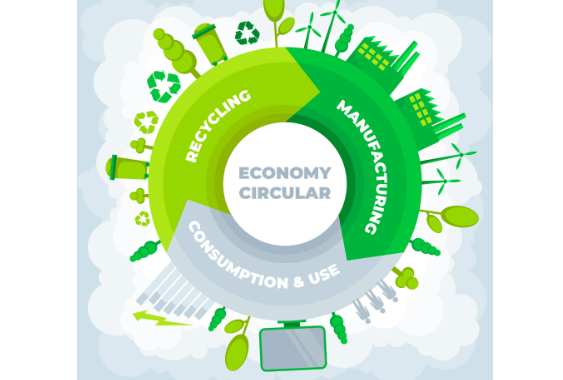
The $4 trillion circular economy business opportunity is based on a straightforward idea: the linear model, which involves extracting raw materials, manufacturing items, using them until they break, and then discarding them, is incredibly inefficient in ways that appear on balance sheets and in landfills. Businesses may capture value that the linear system just discards by figuring out how to recover, reuse, and prolong the life of materials and goods.
In the context of corporate finance, the dimension that stands out the most is material savings. The recent volatility of commodity prices for virgin raw materials, such as lithium, cobalt, copper, rare earths, and specialty polymers, has made procurement a real strategic risk. In addition to lowering their exposure to that volatility, businesses that manufacture goods using recovered or recycled materials also reap the marketing benefits of having a smaller environmental effect. Although it is debatable which incentive is more effective for a particular business in a particular industry, the result—moving toward recovered and recycled inputs—is the same regardless.
Businesses that could have otherwise proceeded more slowly are seeing an acceleration of their timetable due to the regulatory environment. Extended producer responsibility rules, ecodesign regulations requiring repairability standards, and packaging directives that force businesses to reconsider how products are packaged, shipped, and recovered at the end of their useful lives are just a few of the circular economy requirements that the European Union has been most active in codifying.
Companies that have been developing circular infrastructure for a number of years are better equipped to handle these demands smoothly. Those who haven’t are finding that it’s much more difficult to retrofit circular principles onto a linear supply chain than it is to design for circularity from the beginning.
In terms of where corporate adoption has truly advanced, it is worthwhile to look at the five business model categories that capture the majority of the circular economy value. Products-as-a-Service has advanced most in industries including industrial equipment, corporate software, and certain consumer electronics categories where the hardware is costly and the client connection is already continuing.
Companies like Airbnb and Zipcar have normalized sharing platforms to the point where the idea no longer feels experimental. As companies like Patagonia, Apple, and an increasing number of automakers invest in certified repair and refurbishment programs that keep products in circulation and customers in the brand ecosystem simultaneously, some of the more intriguing business building is currently taking place in the remanufacturing and repair category of product life extension.
