


Many hospitals still have the same waiting area. A couple of plastic seats. the subtle antiseptic odor. While nurses move silently through the hallways, patients browse through their phones. However, medicine is starting to act differently behind the scenes, within servers, databases, and cloud systems. The room is being filled with algorithms.
It’s difficult to ignore the pattern’s emergence. The same data systems that help Amazon predict what might end up in a shopping cart or tell Netflix which show someone will binge on next are now being trained to identify illness. At first, the concept seems almost bizarre. However, it turns out that medicine generates far more data than any one physician can comprehend, including lab tests, scans, prescriptions, and genetic information. That is precisely the kind of complexity that algorithms thrive on.
| Category | Information |
|---|---|
| Field | Artificial Intelligence in Healthcare |
| Key Technologies | Machine Learning, Deep Learning, Natural Language Processing |
| Major Players | Google DeepMind, IBM Watson, health-tech startups |
| Key Applications | Diagnostics, medical imaging, drug discovery, precision medicine |
| Healthcare Model Shift | From reactive treatment to proactive health management |
| Estimated Cost Savings | Up to $150 billion annually in U.S. healthcare by 2026 |
| Key Data Sources | Electronic health records, genomic sequencing, wearable devices |
| Example Use Case | AI detecting cancer in radiology images |
| Official Reference | https://www.who.int/health-topics/artificial-intelligence |
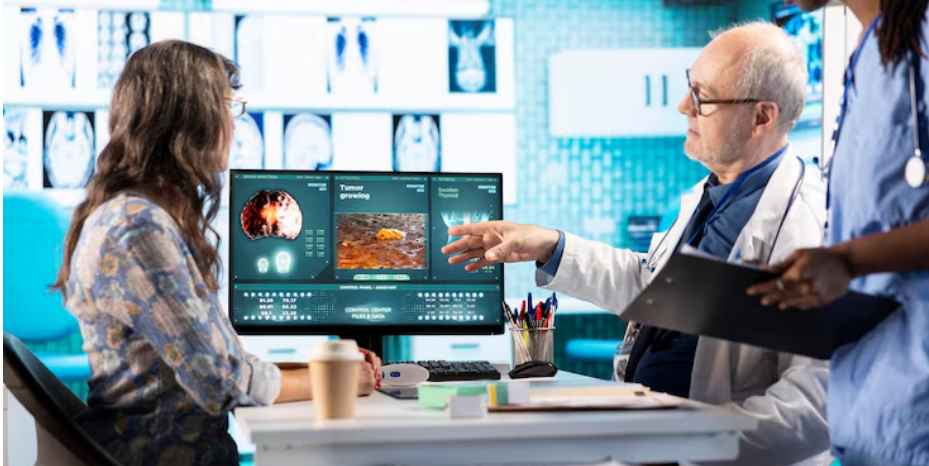
The change is already apparent in radiology departments. Large screens glow with MRIs and CT scans, and somewhere behind the software interface, an algorithm is silently analyzing every picture, looking for irregular shapes or minute patterns in tissue density. These systems are sometimes able to identify tumors with accuracy comparable to that of skilled professionals. The medical community has been both excited and a little uneasy about that fact alone. Naturally, doctors still have the last say. However, the machine is making more and more suggestions in whispers.
There’s a feeling that quicker diagnoses aren’t the only thing that has changed. It has to do with an alternative medical philosophy that emphasizes prediction over reaction. Healthcare has essentially operated like emergency repair for many years. Someone becomes ill. Physicians react. The course of treatment starts. Another promise is made by algorithms.
AI systems may start detecting risks years before symptoms manifest by examining enormous datasets, including genetic information, lifestyle data, and electronic medical records. The genome of a patient may indicate susceptibility to a specific type of cancer. Long before a hospital visit is required, wearable technology may identify subtle cardiac irregularities. Future medicine might feel more like weather forecasting than firefighting.
At the heart of this change is precision medicine. Treating each patient as a distinct biological system rather than as a member of a typical population is a straightforward but surprisingly complicated concept. In ways that previous healthcare models frequently disregarded, genetics, environment, diet, microbiome, and family history all begin to matter. Because algorithms can sort through variables that would be too complex for human reasoning, they are helpful.
Another area where the algorithmic shift is subtly gaining traction is drug discovery. It typically takes more than ten years to bring a new medication to market. Along the way, thousands of potential molecules fail. Trials that are never approved cost billions of dollars. That search is starting to get shorter thanks to machine learning.
These days, researchers use massive chemical databases—millions of molecular structures kept in libraries like PubChem or ChEMBL—to train models. In order to predict which substances might genuinely function as medications, the algorithm starts identifying patterns in the way molecules interact with biological targets. Observing this process in action is similar to witnessing software evolution accelerate. The narrative isn’t entirely upbeat, though.
Algorithms seldom fit neatly into current workflows because healthcare systems are complex organisms. Watson from IBM had to learn that lesson the hard way. The messy reality of hospital systems, insufficient data, and the huge variation between patients dashed early hopes that Watson could swiftly transform cancer treatment. The technology was effective. Integration turned out to be more difficult.
Additionally, there is the issue of trust. Many doctors are still hesitant to entrust decisions to opaque machine-learning models because they have spent years honing their judgment. In particular, deep learning systems frequently act like “black boxes,” generating results without providing a clear explanation.
That opacity can be unsettling for a profession that is based on accountability and evidence. Nevertheless, it is hard to ignore the momentum.
AI systems that forecast patient decline hours before obvious symptoms manifest are being tested in hospitals. Algorithms that prioritize new patients based on minute signals concealed in vital signs are being tested in emergency rooms. Neural networks are being used by researchers to find genetic mutations associated with uncommon diseases that have long perplexed medical professionals.
As these advancements take place, a quiet realization is permeating the medical community. Doctors might not be replaced by algorithms. That concept seems more and more simplistic. However, they might alter medical professionals’ perspectives, diagnoses, and treatments.
From stethoscopes to MRI scanners, medicine has always developed alongside technology. A doctor may not be able to use the next tool.
It could exist inside an algorithm that is constantly learning, sifting through billions of data points, and looking for patterns that are impossible for humans to fully comprehend. Additionally, the direction of this transformation seems clear even though it’s still unclear how far it will go. Healthcare is starting to speak the language of data, albeit slowly and with some caution.
