

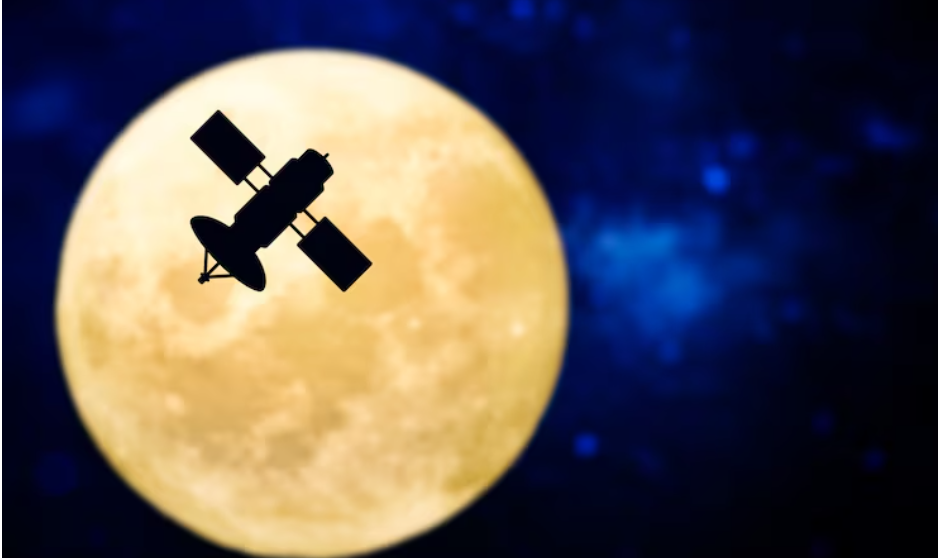

The odd thing about the night sky nowadays is that most people hardly ever look at it. In urban areas, the stars are obscured by glowing apartment windows and orange streetlights. Something else, though, has moved silently above. thousands of satellites. Every month, more arrive. Additionally, scientists are starting to question whether the expanding spacecraft may be influencing people’s sleep cycles in ways that most people are unaware of.
Recently, Northwestern University researchers issued a warning that initially seems almost unreal. The Earth’s natural cycle of light and dark could be gradually altered by satellites intended for communications, internet access, and even nighttime lighting. It’s possible that night will not exactly turn into day. However, it may cease to be completely dark.
| Category | Information |
|---|---|
| Topic | Satellite Light Pollution and Human Sleep |
| Key Research Institution | Northwestern University |
| Key Scientific Field | Circadian Rhythm Research |
| Key Technology Companies | SpaceX, Reflect Orbital |
| Example Satellite Network | Starlink |
| Current Satellites in Orbit | Over 12,000 active and inactive satellites orbit Earth |
| Scientific Concern | Artificial night light disrupting circadian rhythms |
| Reference Source | https://news.northwestern.edu |
It already feels different to stroll through a city after midnight than it did a century ago. Signs with neon lights hum. Sidewalks are washed pale yellow by street lamps. In apartment buildings where someone is constantly awake, windows glow. The body interprets this phenomenon, which scientists refer to as “artificial light at night,” as a biological signal. Sleep comes from darkness. Light is a sign of awakening. Things start to drift once that signal gets jumbled.
The circadian rhythm is the internal clock that powers the human body. Hormone levels, digestion, body temperature, and sleep patterns are all regulated by it. Circadian rhythm research is frequently described by researchers as surprisingly delicate. Melatonin, the hormone that subtly signals to the brain that it’s time to relax, can be suppressed by even slight variations in nighttime light. Imagine now that the sky is becoming brighter.
Over 12,000 satellites are currently in orbit around the planet, traveling at a speed of roughly 17,500 miles per hour in low-Earth orbit. Many are part of communication networks such as SpaceX’s Starlink, which provides worldwide internet coverage. The majority are tiny and hard to spot unless you know where to look. However, astronomers are a little concerned about their growing brightness.
Some satellites glide across the sky like slow-moving stars, reflecting sunlight long after sunset. Astronomers occasionally observe them passing in silent lines at isolated observatories in Chile or Arizona. One after the other. A slow but steady march. The more ambitious plans come next.
Reflect Orbital, a California startup, has suggested launching mirror satellites that would reroute sunlight to Earth at night. On paper, the idea seems feasible. Disaster areas could be illuminated by emergency response teams. The hours that solar farms operate could be extended. After dark, construction workers could continue to work.
However, the concept also poses a straightforward query that is currently unanswered. When night ceases to be consistently dark, what happens?
Ecosystem scientists are already aware that wildlife is confused by artificial light. Instead of crawling toward the ocean, sea turtle hatchlings frequently head toward bright coastal cities. Sometimes migratory birds run into illuminated buildings. Even plants depend on seasonal variations in daylight to initiate dormancy and flowering. It turns out that humans are not all that different.
Short circadian rhythm disruptions, according to doctors, can have minor but noticeable effects like fatigue, irritability, and poor concentration. If you prolong that disruption over several months or years, the repercussions become more severe. Sleep disturbances manifest. The metabolism changes. Heart disease, diabetes, and depression risks gradually increase.
Satellite light might not be enough to push people over the edge. Cities are already bright places, after all. However, scientists believe the cumulative effect might be significant. A dim but enduring glow is added to the night sky by light reflecting back toward Earth after bouncing off satellites.
The sky still appears sufficiently dark when standing outside late at night, particularly in more sedate suburbs or rural areas. However, astronomers claim that sensitive measurements reveal the difference. In many places, the night sky’s background brightness has already increased.
The enormity of what might happen next is another factor. According to some estimates, low-Earth orbit may eventually be populated by hundreds of thousands of satellites. Siegfried Eggl, an aerospace engineer, once observed that the human eye can only see roughly a thousand stars. The sky itself starts to change when hundreds of thousands of moving objects are added.
As that change takes place, it seems as though space technology has reached the same stage as the internet. First, rapid expansion. Later, there will be questions.
Businesses that implement these systems maintain that the risks are controllable. According to engineers, coatings and design changes can lower brightness. For its lighting system, Reflect Orbital has even proposed a type of dimmer switch that produces a glow more akin to twilight than daylight.
Perhaps they are correct. Whether satellite light will significantly disrupt people’s sleep patterns on a large scale is still unknown. The evidence is still preliminary and somewhat dispersed.
Even so, it’s difficult to ignore how rapidly technology is taking over the night sky. Space seemed empty and far away a generation ago. Quietly circling above the atmosphere, it now looks like a new layer of infrastructure.
And the body, obstinately old, continues to anticipate what it did thousands of years ago. Shadows. Quiet. A starry sky.
