

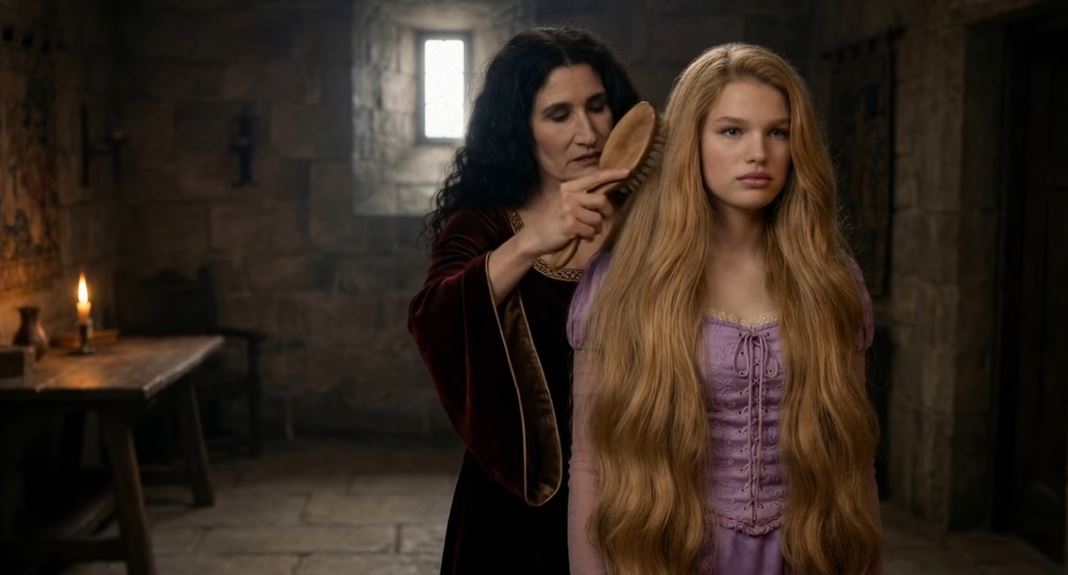

Bringing a tale like Tangled into the real world has an oddly delicate quality. The 2010 original movie was more than just another animated hit; it had a delicate quality, a kind of radiant warmth that was hard to duplicate. And yet here we are, watching Disney try it once more, cautiously, almost cautiously, as the live-action version begins to take shape.
The pieces appear to fit on paper. Teagan Croft has been cast as Rapunzel, a role that is more emotionally significant than it might first seem. Given her reputation for portraying darker, more nuanced roles, the casting seems a little surprising. Perhaps that’s the point, though. There’s a sense that Disney isn’t just recreating the character—they might be trying to reinterpret her.
| Category | Details |
|---|---|
| Film Title | Tangled (Live-Action) |
| Studio | Walt Disney Pictures |
| Director | Michael Gracey |
| Lead Cast | Teagan Croft (Rapunzel), Milo Manheim (Flynn Rider) |
| Villain | Kathryn Hahn (Mother Gothel) |
| Writer | Jennifer Kaytin Robinson |
| Original Film | Tangled (2010) |
| Genre | Musical Fantasy Adventure |
| Filming Location | United Kingdom (reported) |
| Release Date | TBA |
| Reference | https://www.imdb.com |
Then there’s Milo Manheim, who plays the endearing outlaw Flynn Rider, who is equal parts self-assured and insecure. His energy is similar to Flynn’s when watching clips of him working on other projects; it’s a little theatrical and chaotic. However, it’s unclear if that enthusiasm will translate in the same way in a movie with well-established expectations.
And the true problem here might be expectations. The success of Disney’s live-action remakes has been inconsistent. While some have experienced commercial success, others have encountered doubt and occasionally even weariness. It’s difficult to ignore the fact that viewers are growing pickier and less inclined to accept a remake just because it exists.
One aspect of this movie’s concept sticks out: the director. Michael Gracey, who is best known for The Greatest Showman, has a distinct visual style that is colorful, dramatic, and frequently inclined toward spectacle. For a tale like Tangled, which thrives on music and visual whimsy, that might be ideal. Alternatively, it could overpower it. It’s hard to say.
The actual production process hasn’t gone without a hitch. After other Disney releases failed to live up to expectations, the project reportedly paused at one point and quietly retreated. That pause seems important. It implies a sort of reluctance within the studio, an understanding that not all animated classics require or profit from a live-action adaptation.
Nevertheless, the project was restarted. According to early reports, filming started in London with sets that heavily rely on practical design. That has a certain comforting quality. Instead of fully virtual environments, there are real towers, real textures, and real physical spaces. This decision might be an attempt to give the story a sense of reality rather than just fantasy.
Another layer is added by Kathryn Hahn’s casting as Mother Gothel. Hahn has a talent for fusing humor with a sharper, almost unnerving quality. It’s easy to envision her playing a more complex version of the character—less cartoon villain, more subtly manipulative presence—after seeing her in previous roles. Viewers will probably disagree on whether that tone is appropriate for the entire movie.
The cultural context is another factor to take into account. Recent years have seen both positive and negative reactions to Disney’s casting strategy. Even before a movie is released, conversations about representation, authenticity, and audience expectations are now commonplace. Regardless of its final form, Tangled might come under similar scrutiny.
The speed at which people form opinions about a movie they haven’t seen is intriguing, though. Casting announcements frequently elicit quick, sometimes even harsh, responses on social media. However, those responses don’t always hold true. Once films are seen as whole experiences rather than bits and pieces of news, they have the power to alter perception.
A subtle conflict between nostalgia and reinvention is evident as this develops. A generation that grew up with the original Tangled loved it, not just liked it. This type of attachment is difficult to break. It persists and shapes expectations in ways that can be challenging to fulfill.
At the same time, there’s a curiosity that keeps returning. What if this version does something slightly different? What if it leans more into emotion, or music, or even darker undertones? It’s possible that the film won’t simply repeat what came before, but adjust it in subtle ways.
Still, uncertainty hangs in the background. Disney has tried this formula many times, with mixed results. Certain movies seem essential. Some are like echoes.
With Tangled, it’s not entirely clear which it will be. However, the tower is being rebuilt, piece by piece. For the time being, people continue to look up and wonder what will happen.
