


Something happened on a morning in late July 2019 in Ethiopian cities, villages, highland fields, and valley floors that is still being talked about, debated, and quietly appreciated in equal measure. Planting 200 million tree seedlings in 12 hours was the government’s goal. In order to allow civil servants to take part, some government offices were closed for the day.
Alongside United Nations representatives were foreign diplomats. In dozens of locations, officials were tasked with counting the number of seedlings planted. The nation’s minister of innovation and technology declared at the end of the day that 353,633,660 trees had been planted—not in a single day, she clarified, but in twelve hours. There were an estimated 23 million participants. Guinness World Records, which had never received an application from Ethiopia to verify it, said in a public statement that they would welcome one because the number was so startling.
The goal of that July day is understandable in light of Ethiopia losing 98% of its forest areas over the past 50 years. Approximately 35% of the nation’s land was covered by forests at the beginning of the 20th century. That percentage dropped to slightly over 4% by the 2000s.
| Ethiopia Green Legacy Initiative — Key Facts | |
|---|---|
| Program Name | Green Legacy Initiative — Ethiopia |
| Date of Record Planting | July 29, 2019 |
| Trees Planted in 12 Hours | 353,633,660 — over 350 million |
| Participants | Estimated 23 million people across Ethiopia |
| Original Target | 200 million seedlings in 12 hours |
| Annual Planting Goal (Green Legacy) | 5 billion trees per year |
| Long-Term National Target | 20 billion trees total; government now targeting 50 billion by 2026 |
| Land Area for Restoration Pledged | 15 million hectares by 2030 (Bonn Challenge commitment) |
| Forest Cover (Early 20th Century) | ~35% of total land area |
| Forest Cover (By 2000s) | Just over 4% — a loss of 98% over 50 years |
| Prime Minister | Abiy Ahmed — launched and led the initiative |
| Seedling Types | Primarily indigenous species; also fruit trees including avocado |
| Guinness World Records Status | Application not submitted as of August 2019 |
| Previous Record Holder | India — 50 million trees by 800,000 people in Uttar Pradesh, 2016 |
| UN Response | UNEP praised the effort; called on other African nations to follow |
| Key Challenge | Seedling survival rates — dependent on rainfall, overgrazing, fencing, and follow-up maintenance |
| Countries Inspired | Pakistan (Billion-Tree Tsunami), India, China, Senegal |
Agricultural expansion, charcoal production, population growth, and overgrazing were the well-known causes, and the results were quantifiable in terms of declining soil quality, increased flooding, more severe droughts, decreased water supply to farming communities, and the silent disappearance of habitats that had sustained both wildlife and the rural economies built around them. Ethiopia lost more than two million animals to drought in 2017 alone. In a nation like Ethiopia, the relationship between forest cover and climate resilience is not an abstract environmental argument. Harvest yields and livestock counts both reflect it.
As part of a larger National Green Development program, Prime Minister Abiy Ahmed started the Green Legacy Initiative in May 2019 with the initial objective of planting four billion trees on 1.5 million hectares by October of that year, or 40 trees per Ethiopian. The planting on July 29th was intended to be the dramatic focal point of that endeavor, a single, well-planned national event that would show scope and create momentum.
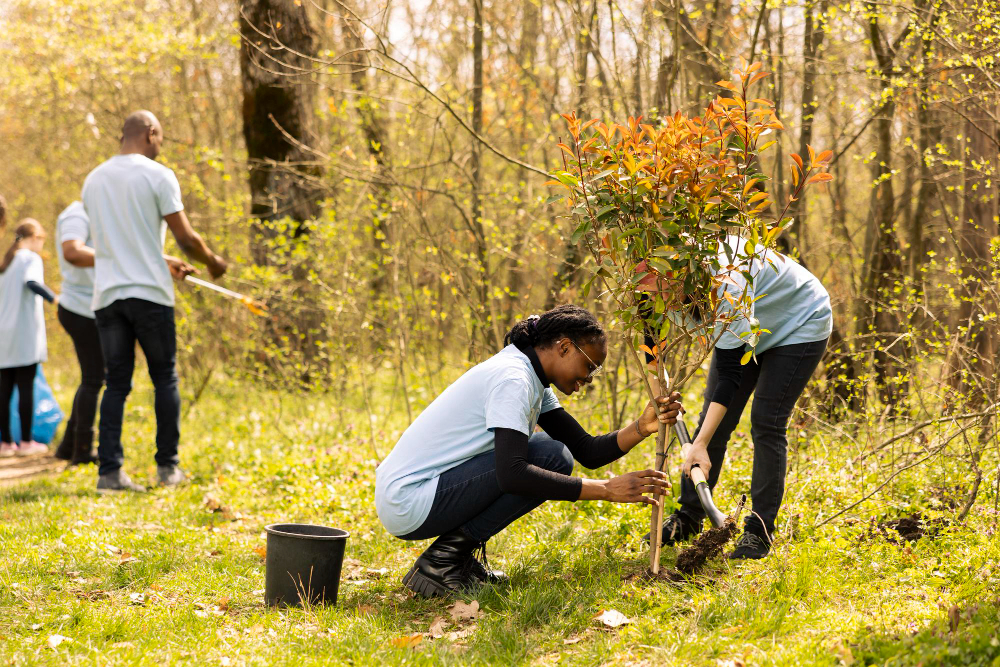
Volunteers nationwide received seedlings three days beforehand. The majority were native species chosen for their ecological suitability for Ethiopia’s diverse terrain, which includes low-lying savannas, semi-arid lowlands, and highland plateaus above 3,000 meters, all of which call for distinct species and planting techniques. In certain places, native species were mixed in with fruit trees, such as avocado trees, resulting in both ecological and food security benefits.
The ensuing skepticism was real and deserving of serious consideration. Guinness had not confirmed the figure. The spokesperson for the opposition Ezema party publicly stated that she didn’t think the number could be reached. One government-affiliated organization’s source told the BBC that although they had been told to plant 10,000 trees, they had only used their own funds to purchase 5,000 of them and reported the entire amount.
The 350 million figure would actually be exceeded if the 23 million participants planted the 100 trees per day that UN forest experts cite as a realistic individual rate, according to the BBC’s Reality Check team. However, there was no independently verified count of how many trees each person actually planted, how many survived their first season, or whether the geographic distribution matched the available land.
These are serious issues. The history of large-scale tree-planting initiatives around the world is replete with seedlings that never reached maturity because they were planted in inappropriate soils, during inappropriate seasons, or in places lacking the community stewardship necessary to shield young trees from drought or grazing animals.
Seedling survival is the program’s biggest long-term challenge, according to the UN Environment Programme, which commended Ethiopia’s efforts and urged other African countries to follow. As part of the Bonn Challenge, Ethiopia committed to restoring 15 million hectares of degraded forest by 2030. To oversee and evaluate the project, the government formed a five-person expert group that included representatives from the UN Development Program. The results of that monitoring, particularly how many of those 350 million seedlings survived their first year, have not been thoroughly documented in a way that makes external evaluation simple.
It is evident that the initiative continued beyond that particular day. Ethiopia is now on track to plant 50 billion trees by 2026, according to the government, and annual commitments of five billion trees have been reported as part of the Green Legacy Initiative. The same data-verification question that surrounded the original record also applies to whether those figures are entirely accurate or represent optimistic official projections.
The impact of the 2019 incident outside of Ethiopia is more evident. Ethiopia’s moment served as confirmation for Pakistan, which is currently operating its Billion-Tree Tsunami project. In 2017, India proved that the idea of mass planting was technically possible by planting 66 million trees in 12 hours. In 2018, China sent troops to plant trees throughout an area the size of Ireland. The World Economic Forum recorded how Ethiopia’s particular example spread throughout governments in Asia and Africa through planning sessions and policy debates.
Looking back on July 29, 2019, it seems more like a proof of concept than a single event. Not perfect: the survival rates were unknown, the numbers were unconfirmed, and the political framing blended with the environmental ambition in ways that made a clear assessment challenging. However, the underlying logic—that decades of deforestation can be reversed more quickly than anyone could have predicted by applying massive human effort at the right time in the right landscape with the right species—has continued to gather supporting data.
A more subdued method of verification than any figure a minister declares at a press conference is the Ethiopian highland communities planting next to trees that were only saplings in 2019 and witnessing the return of shade to slopes that were barren when they were young. The forests are expanding. The story is still being written about how many, how quickly, and in what condition.
